Kerbside Considerations: A Measured Look at Blue Badge Applications and MS
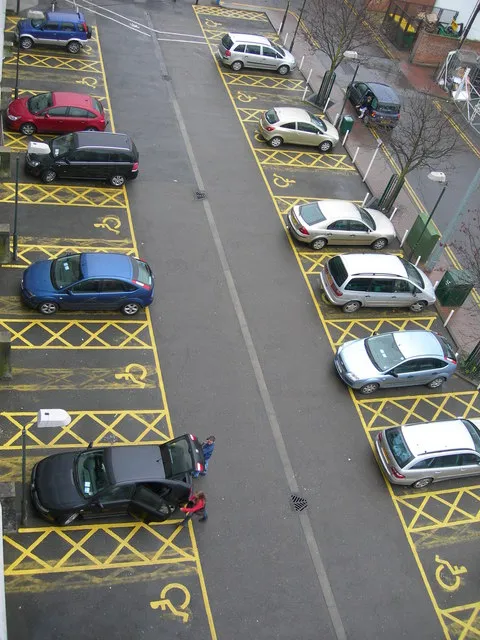
Photo: Danny Robinson, CC BY-SA 2.0, via Wikimedia Commons
A Blue Badge is, at heart, a parking concession. It is not a verdict on how disabled you are, nor a reward for coping well, nor a certificate that settles the question of identity. For many people with multiple sclerosis, it is simply one practical tool among several: a way to shorten the distance between the car and the appointment, the shop, the school gate or the front door. Thinking about applying can still feel loaded. The form asks questions that MS answers unevenly, and the language of eligibility can sound harsher than the reality of an ordinary week.
This guide is about preparation rather than persuasion. The rules are set by the administering body in your part of the UK, and the precise wording matters. What follows is a calm way to approach the application, describe a fluctuating condition clearly, and use a badge sensibly once it arrives.
What the scheme is for
The Blue Badge scheme provides parking concessions for people with severe mobility difficulties. In England, Scotland and Wales, applications are generally handled by local authorities; Northern Ireland has its own arrangements. Some people qualify automatically because they receive a qualifying rate of a listed benefit, such as PIP with the enhanced mobility component or Adult Disability Payment at the enhanced rate. Others apply through a further assessment route, where the focus is on how walking and journeys are affected in practice.
For many people with MS, the relevant questions are not about diagnosis but about function. Can you walk without considerable difficulty or discomfort? Does walking risk harm to you or others? How far can you go, at what pace, and with what consequence afterwards? These are not abstract matters. They are the difference between a manageable outing and a day spent recovering from it.
Describing a moving target
MS is rarely tidy. A form that asks about a typical day can feel like a trap, because there may be no typical day. The useful response is not to exaggerate the worst moment or to minimise it in the name of stoicism, but to describe the range honestly and explain what the range means.
A short diary can help. Over two or three weeks, note the days when walking felt straightforward and the days when it did not. Record distance, time, aids used, whether you needed an arm or a wall, whether you had to stop, and how long it took to recover. Note the conditions that change things: heat, fatigue, a relapse, a urinary infection, poor sleep, a busy week. If your symptoms fluctuate, say so plainly and give examples. A sentence such as 'on a good day I can manage the length of a small car park; on a bad day I cannot cross a road without stopping' is more useful than a general statement about mobility problems.
It also helps to explain the cost of walking, not only the act. MS fatigue is not ordinary tiredness, and the recovery time after a short walk is relevant to whether that walk is feasible in the first place. Balance, foot drop, spasticity, pain, vision and heat sensitivity may all play a part. The form may not have a box for every symptom, but the supporting information can describe how they combine.
Evidence that speaks to function
A diagnosis of MS, on its own, does not answer the eligibility question. Evidence is most helpful when it describes what you can and cannot do, and how reliably. A letter from your MS nurse, neurologist, physiotherapist or occupational therapist can be valuable if it addresses function rather than merely confirming the diagnosis. Ask whether they can comment on walking distance, balance, fatigue, the use of aids, and the variability of your symptoms. A copy of your care plan or clinic summary may help.
Other documents can support the picture: a prescription list, a report from a falls clinic, or a decision letter for a related benefit that sets out functional needs. Keep copies of everything you send. If someone helps you complete the form, make sure the words sound like you and reflect your circumstances, not a generic description of MS.
Completing the form without overstating or understating
Answer the questions asked, in plain language. Use specific examples and avoid assuming the assessor will infer the rest. If a question asks about walking, describe walking. If it asks about danger, describe the circumstances in which you feel unsafe: uneven pavements, crossing without a controlled crossing, crowded spaces, poor lighting, a flare-up of symptoms. If your needs vary, explain the pattern rather than choosing only the best day or only the worst.
It is reasonable to ask for help with the form if fatigue, cognition or dexterity make it difficult. It is also reasonable to take a copy before sending it. The application is not a test of resilience. Nor is it a place to catalogue every symptom in the hope that volume will persuade. Clarity is more persuasive than accumulation.
Renewals and changes in circumstance
Blue Badges are usually issued for a fixed period, often three years, and the expiry date is printed on the badge. Councils may send a renewal reminder, but it is safer not to rely on it. Diarise the expiry date and begin the renewal process in good time, particularly if you need fresh supporting evidence. Renewal is not always a formality, and the evidence should reflect your current situation rather than the position three years ago.
If your mobility changes significantly before the badge expires, you can contact the issuing authority to ask what to do. The same applies if your circumstances change in a way that affects eligibility. Keep the conversation factual and keep a record of dates and reference numbers.
Using the badge day to day
The badge belongs to the person, not the vehicle. It can be used in a car in which you are travelling as a driver or passenger, provided you are present. It should be displayed correctly, with the clock set where one is required for on-street time limits. Rules differ between on-street parking and off-street car parks, and some car parks still charge. Read the signs rather than assuming that the badge covers everything.
Used well, the badge can reduce the uncertainty of an unfamiliar journey. It may widen the choice of parking and shorten the walk to a destination. It does not remove the need to plan, and it does not guarantee a space. Some people find it helpful to check council parking maps or accessible parking information before setting out, and to allow for the possibility that the nearest bay is occupied.
Travel, anxiety and the limits of a badge
A badge can ease some of the anxiety around going out, but it is not a solution to every barrier. Noise, crowding, heat, toilets, seating and the unpredictability of a journey all matter. If travel anxiety is significant, it may be worth discussing with your MS team or a clinician who understands the wider picture. The badge is one support, not a measure of independence.
If the answer is no
A refusal is not the end of the conversation. Ask for the decision and the reasons in writing. Councils have review or appeal routes, and the wording varies, so check the information sent with the decision. New functional evidence is often more useful than a letter of frustration. If your circumstances change, you can apply again.
The Blue Badge question is worth asking, but it does not need to be asked in a spirit of confrontation. It is a practical matter: describe your walking and your journeys honestly, gather evidence that speaks to function, and use the badge in the way it is intended. For many people with MS, that is enough to make the kerbside a little less daunting.